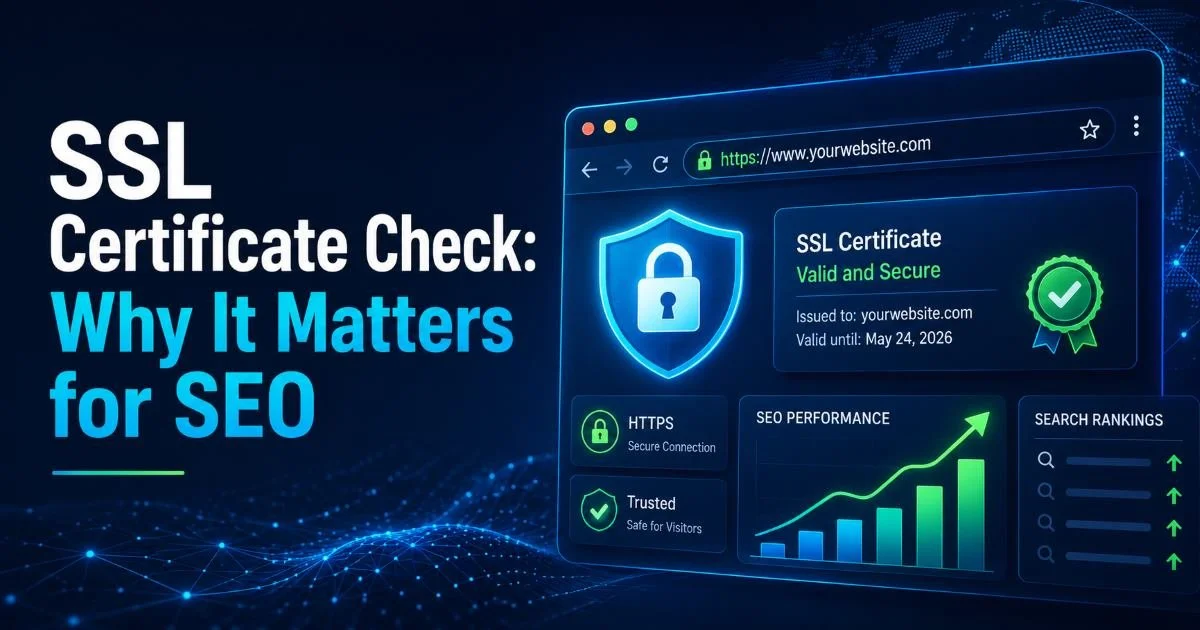
An SSL certificate check is no longer just a security hygiene task; it directly influences how search engines rank your website. If you manage domains and haven't performed a thorough domain security scan recently, you're likely leaving SEO value on the table.
Google confirmed HTTPS as a ranking signal back in 2014, and the weight of that signal has only grown since. Yet many IT administrators and webmasters treat SSL configuration as a one-and-done task, ignoring expiration dates, mixed content warnings, and DNS misconfiguration issues that quietly erode trust signals.
A vulnerability scan that catches these problems early can protect both your security posture and your organic visibility. This article takes a clear stance: SSL certificate management is an SEO discipline, not just an infrastructure concern. As part of a broader domain security scanning strategy, SSL checks deserve a permanent spot in your monthly workflow.
Key Takeaways
- Expired or misconfigured SSL certificates can directly lower your search engine rankings.
- Google Chrome flags HTTP sites as "Not Secure," increasing bounce rates significantly.
- Regular domain vulnerability scans catch certificate issues before they impact SEO performance.
- Mixed content errors silently break HTTPS trust signals that search engines rely on.
- Free certificate authorities like Let's Encrypt eliminate cost as an excuse for missing SSL.
The Direct Connection Between SSL Certificates and SEO
Google's HTTPS Ranking Signal
Google officially announced HTTPS as a lightweight ranking signal in August 2014. At the time, the company described it as a "very lightweight signal" affecting fewer than 1% of global queries. But that was a decade ago. Internal studies from SEO platforms now suggest HTTPS adoption among top-ranking pages exceeds 95%, which means lacking SSL puts you in a shrinking minority that search algorithms increasingly penalize through relative disadvantage.
The ranking boost isn't dramatic in isolation. You won't jump from page five to page one by adding an SSL certificate. However, in competitive niches where dozens of sites battle for position, every marginal signal matters. Think of HTTPS as table stakes: its absence hurts you more than its presence helps you. Search engines interpret a valid certificate as a baseline trust indicator, and failing that baseline sends a negative quality signal.
User Trust and Bounce Rate Impact
Chrome, which holds roughly 65% of the global browser market, displays a prominent "Not Secure" warning for any page served over HTTP. Firefox and Edge follow similar patterns. These warnings cause measurable user behavior changes. A study by HubSpot found that 82% of users would leave a site displaying a security warning. High bounce rates feed directly into Core Web Vitals and user experience signals that Google monitors for ranking decisions.
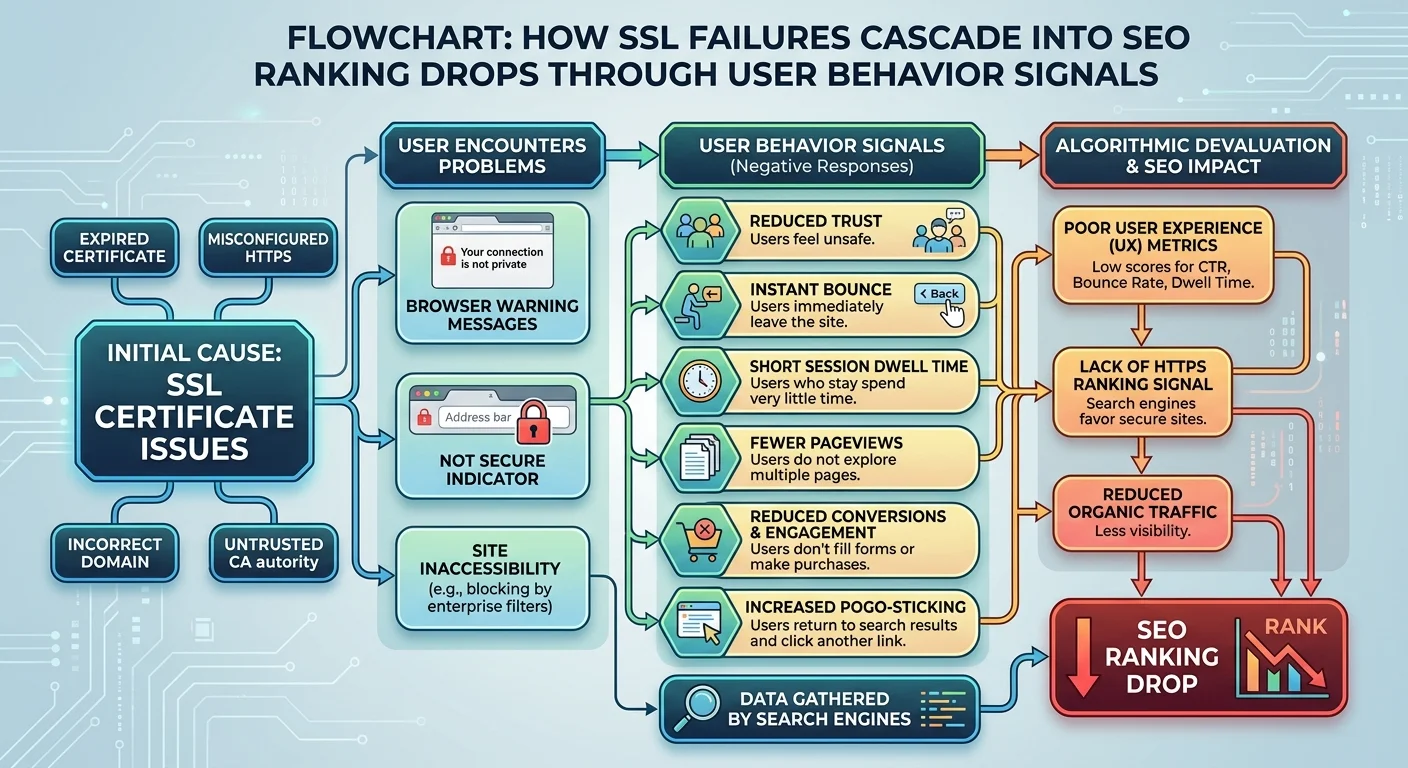
The cascade is straightforward. A missing or expired SSL certificate triggers a browser warning. Users bounce. Google registers the short session duration and high bounce rate. Over time, the algorithm interprets this as poor user experience and adjusts rankings accordingly. The technical failure becomes a behavioral signal, and the behavioral signal becomes a ranking penalty. IT administrators who dismiss SSL as "just a cert" are missing this feedback loop entirely.
"SSL certificate management is an SEO discipline, not just an infrastructure concern."
Common SSL Failures That Hurt Rankings
Expired and Misconfigured Certificates
Certificate expiration is the most common and most preventable SSL failure. Let's Encrypt certificates expire every 90 days, and auto-renewal scripts can fail silently due to DNS changes, server migrations, or permission errors. When a certificate expires, browsers immediately block access or show full-page warnings. Googlebot also struggles with expired certificates, sometimes dropping pages from the index within days of the certificate lapsing.
A single expired certificate can cause Googlebot to deindex hundreds of pages within 48 to 72 hours.
Certificate chain errors are nearly as damaging but harder to detect without a proper security check tool. If your server doesn't present the full chain (root certificate, intermediate certificates, and your domain certificate), some browsers and crawlers will reject the connection. This often happens after server migrations when administrators install the primary certificate but forget the intermediates. The site appears fine in Chrome on desktop but fails validation in older Android browsers and certain bot user agents.
Mixed Content Traps
Mixed content occurs when an HTTPS page loads resources (images, scripts, stylesheets) over HTTP. Modern browsers block mixed active content entirely and display warnings for mixed passive content. This breaks page functionality and degrades user experience. Worse, search engines may see the page as only partially secured, reducing the trust signal that HTTPS is supposed to provide.
Identifying mixed content requires scanning every page, not just your homepage. A thorough domain vulnerability scan will flag HTTP resource calls embedded deep in template files, third-party widgets, or legacy CMS content. Many webmasters fix their homepage SSL configuration and call it done, never realizing that hundreds of internal pages still reference HTTP assets. This is exactly the kind of DNS misconfiguration and infrastructure oversight that automated scanning tools catch efficiently.
| SSL Issue | SEO Impact | Detection Method | Fix Difficulty |
|---|---|---|---|
| Expired Certificate | Page deindexing within days | Automated monitoring | Easy |
| Incomplete Certificate Chain | Crawl errors on some user agents | SSL checker tools | Moderate |
| Mixed Content | Reduced HTTPS trust signal | Full site scan | Moderate |
| Wrong Domain on Certificate | Complete site access block | Certificate audit | Easy |
| TLS 1.0/1.1 Only | Browser warnings, user drop-off | Protocol scan | Moderate |
| HSTS Not Configured | Potential downgrade attacks | Header analysis | Easy |
Run a full-site crawl monthly to detect mixed content issues that creep in through CMS updates or new third-party integrations.
Building SSL Checks Into Your SEO Workflow
Automated Monitoring Tools
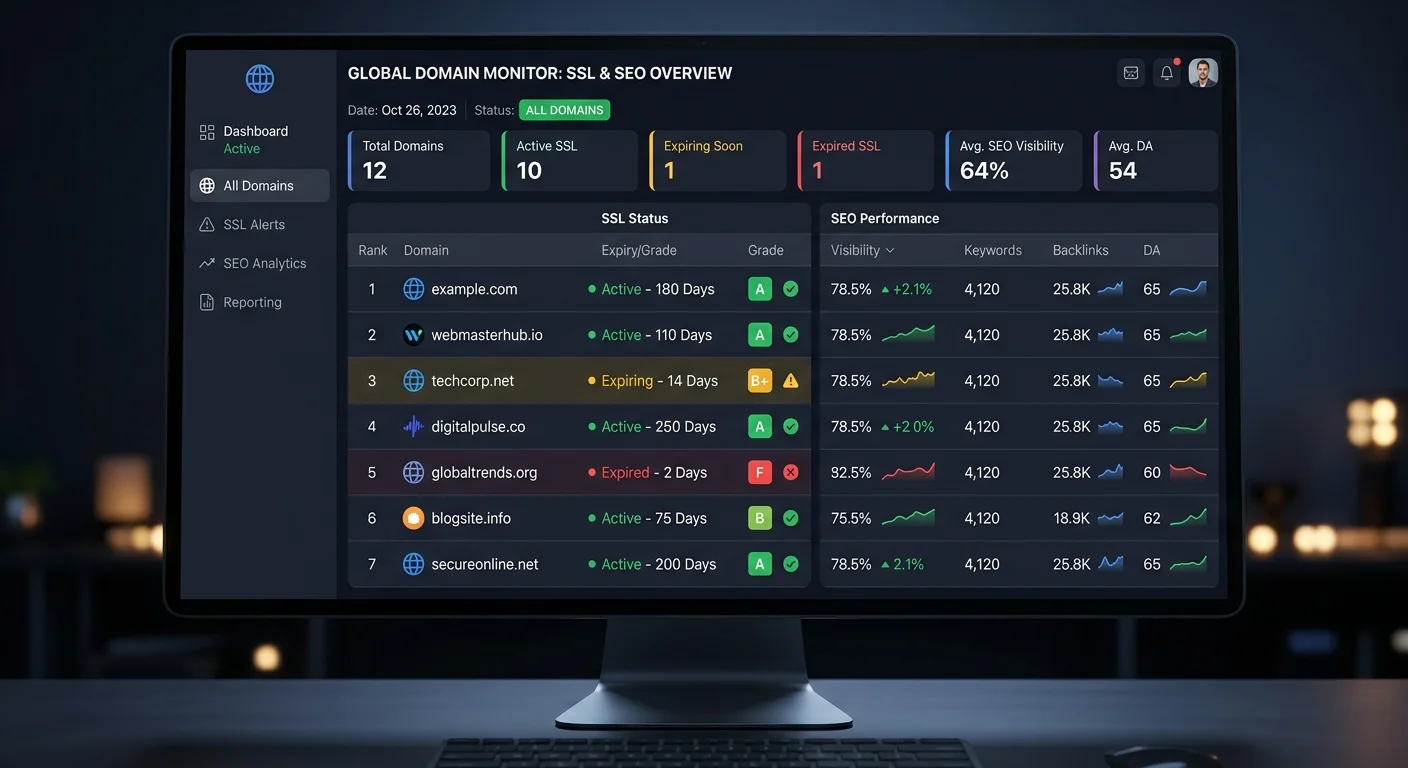
Manual certificate checks don't scale. If you manage more than a handful of domain authorities, you need automated monitoring that alerts you before expiration, detects chain errors, and flags protocol downgrades. Services that combine domain security scanning with SEO auditing provide the most actionable data because they correlate certificate issues with crawl errors and ranking fluctuations. Modern AI-powered SEO tools increasingly integrate SSL health data into their dashboards, recognizing the tight coupling between security and search visibility.
Set certificate expiration alerts for at least 30 days before the renewal date. If you use Let's Encrypt with certbot, test your auto-renewal with a dry run after every server change. Log these tests. The five minutes it takes to verify auto-renewal is nothing compared to the days of lost traffic from an expired certificate. Your monitoring stack should also verify that HTTP-to-HTTPS redirects function correctly, because a broken redirect means search engines index the insecure version of your site.
Let's Encrypt renewal failures often go undetected because the cert still appears valid until expiration day. Test renewals proactively.
DNS and Security Check Alignment
SSL certificates don't exist in a vacuum. They depend on correct DNS configuration, proper CNAME or A record setup, and functional CAA (Certificate Authority Authorization) records. A comprehensive DNS security check alongside your certificate audit prevents situations where DNS changes break certificate validation. For example, migrating to a new CDN can change the IP address your domain points to, potentially invalidating domain-validated certificates that rely on specific DNS challenges.
HSTS (HTTP Strict Transport Security) headers add another layer that most administrators overlook. Once configured, HSTS tells browsers to always use HTTPS, preventing protocol downgrade attacks and ensuring consistent secure connections. From an SEO perspective, HSTS eliminates the possibility of search engines accidentally indexing HTTP URLs, which creates duplicate content problems. Pair HSTS with proper 301 redirects from HTTP to HTTPS, and you have a clean, authoritative signal that both users and crawlers trust.
Counterarguments and the Reality
Some SEO professionals argue that HTTPS is such a minor ranking factor that obsessing over SSL configuration is wasted effort. They point to Google's own description of it as "lightweight" and suggest time is better spent on content quality and backlink building. This argument has merit on its surface. Content will always matter more than any single technical signal. No amount of SSL perfection will rank thin content.
But this framing creates a false dichotomy. SSL certificate management doesn't compete with content strategy for resources; it complements it. A valid, properly configured certificate takes minutes to maintain with the right automation. The real cost isn't in maintaining SSL. It's in failing to maintain it and losing rankings you worked months to earn. One certificate expiration during a critical traffic period can undo weeks of content optimization and link building.
There's also the compounding effect to consider. SSL status affects user trust, which affects bounce rate, which affects behavioral signals, which affects rankings. Ignoring any link in that chain because you consider it "minor" reflects a misunderstanding of how modern search algorithms synthesize hundreds of signals into a single ranking decision. The administrators who treat security and SEO as separate disciplines consistently underperform those who see them as connected.
Finally, consider the competitive landscape. If 96% of top-ranking pages use HTTPS with valid certificates, operating without one places you in the bottom 4%. You're not fighting for a marginal advantage; you're avoiding a clear disadvantage. In competitive SERPs, where the difference between position three and position eight can mean a 70% traffic difference, no rational administrator would accept that handicap voluntarily.
Frequently Asked Questions
?How often should I run a domain security scan for SSL issues?
?Does fixing SSL actually move rankings, or is the boost too small to matter?
?Is there a free way to get SSL so cost isn't a barrier?
?Can mixed content errors cancel out an otherwise valid SSL certificate?
Final Thoughts
SSL certificate checks belong in every webmaster's monthly SEO audit, not buried in an annual security review. The connection between valid certificates, user trust, behavioral signals, and search rankings is too well documented to ignore.
Automate your monitoring, scan for mixed content regularly, and align your DNS security checks with your certificate management. Treat your SSL configuration as what it truly is: a foundational SEO asset that protects both your users and your organic visibility.
Disclaimer: Portions of this content may have been generated using AI tools to enhance clarity and brevity. While reviewed by a human, independent verification is encouraged.